

Work truck window tint is one of the most overlooked upgrades a Rio Grande Valley contractor can make, and a quality contractor vehicle tint job pays for itself in tool protection, heat reduction, and saved AC bills before the first summer ends.
Table of Contents
ToggleYour cab climbs past 140°F by noon, or the Milwaukee battery on the dash starts venting, or the dashboard plastics on your three-year-old F-250 are already cracking like dry caliche.
Every tradesperson in Hidalgo, Cameron, Starr, and Willacy Counties knows the routine: hunt for shade, idle the engine, or come back to a sauna full of melted caulk tubes.
Three problems hit work trucks harder than daily commuters:
- Tools and electronics live in the cab all day, baking in solar gain a sedan never sees.
- Crew cabs hold two to five people through long shifts, and a 115°F cab between calls drains productivity fast.
- Dashboard cracking, sensor failure, and AC compressor burnout cost more than tinting a fleet ever would.
Tint-On-Wheels has installed window film on contractor pickups, service vans, and fleet trucks across the Rio Grande Valley since 1998.
Below is exactly how work truck window tint delivers tool protection against heat, why contractor vehicle tint choices differ from passenger-car tinting, and which films hold up in McAllen, Edinburg, and Brownsville summers.
Key Takeaways
Is window tint worth it for a work truck?
Window tint is worth it for any work truck driven in the Rio Grande Valley because it directly protects tools, dashboard electronics, and crew comfort. Quality ceramic film reduces cab temperatures by 15 to 25°F and blocks 99% of UV rays that crack vinyl, fade upholstery, and shorten lithium-ion battery life.
What is the best tint percentage for a contractor truck?
The best percentage for a contractor truck in Texas is 35% VLT on front windows and 20% or darker on rear windows. 35% clears the Texas 25% VLT minimum with margin while delivering serious heat rejection. Rear cab windows can go as dark as the owner wants under the dual side mirror rule.
Does work truck tinting void factory warranties?
Professional work truck window tinting does not void factory vehicle warranties on Ford, Chevy, GMC, Ram, or Toyota trucks. Federal law under the Magnuson-Moss Warranty Act prevents manufacturers from voiding coverage unless they prove the aftermarket film directly caused a failure. Ceramic and carbon films contain no metal and cause no electronic interference.
How long does work truck tint installation take?
A standard four-door crew cab takes 90 minutes to two hours for full tinting. Larger work trucks with rear sliders or camper shells take longer. Mobile installation at your shop or yard takes the same time and eliminates truck downtime.

Why Work Trucks Need Different Window Tint Than Daily Commuters
A work truck operates under thermal stress no commuter sedan experiences. Service vehicles park in direct sun for hours at remote sites, idle through long appointments, and carry cargo that punishes the cab from the inside out.
An untinted pickup cabin reaches 140 to 160°F within 30 minutes of parking in McAllen summer sun. Dashboards hit 190°F. Steering wheels become unsafe to touch. Tablets used for invoicing and dispatch shut down at 113°F internal temperature. Cordless drill batteries lose calendar life every time they cycle past 130°F.
Quality contractor vehicle tint changes the profile. Premium ceramic film rejects up to 96% of infrared radiation, the wavelength responsible for heat buildup. Cab temperature gaps between a tinted and untinted truck parked side-by-side in a Hidalgo County jobsite lot frequently exceed 20°F.
Work trucks also operate longer service lives than commuter cars. A fleet F-250 may run 300,000 miles over a decade. Window film blocks 99% of UVA and UVB radiation according to the Skin Cancer Foundation, protecting dashboard plastics, leather, vinyl, and any tool stored on the seat.
⭐⭐⭐⭐⭐ “Today I had an awesome experience taking my F-150 to get my moonroof tinting. They were very helpful in explaining what would be the best tint for my truck. Within an hour the work was completed and I was on my way home. I love that I am not getting the heat that was coming through the glass before. My truck feels more comfortable now.”
- Joe Puente

How Does RGV Heat Damage the Tools in Your Truck?
Heat damage in work trucks falls into three categories: battery degradation, electronics failure, and material breakdown. All three accelerate sharply once cab temperatures cross 130°F.
Lithium-ion tool batteries lose capacity permanently every cycle above 113°F. A Milwaukee M18 or DeWalt FlexVolt pack left on a dash through one McAllen afternoon loses measurable runtime. Manufacturers void warranty on heat-damaged cells, so the cost falls on the contractor.
Tablets, phones, GPS trackers, and ELD devices have operating temperature ceilings around 113°F to 122°F. Above that range, screens shut down, batteries swell, and dash mount adhesives let go. A tablet that loses a route mid-job costs a service call and the fuel to return.
Adhesives and consumables degrade fast under heat. Tubes of construction adhesive and silicone cure inside their packaging. Spray paint cans build dangerous pressure. Pre-mixed mud and grout become unusable.
Drivers commuting along Expressway 83 between McAllen and Pharr, or Highway 281 through Edinburg up to Rio Grande City, face direct afternoon sun for hours. Ceramic film cuts the thermal load at the glass before it becomes an interior problem.
💡 Tip: Store battery packs in an insulated tool bag inside a tinted cab rather than loose on the seat or dash. Tint reduces ambient cab heat, and the bag adds a second thermal buffer that keeps lithium-ion packs in their safe storage range on 105°F afternoons in Brownsville and Harlingen.
What Texas Law Says About Tinting Work Trucks and Commercial Vehicles
Texas applies the same window tint laws to work trucks, fleet pickups, and commercial vehicles as it does to passenger cars. Under Texas Transportation Code Section 547.613, front side windows must allow at least 25% of visible light through the film and glass combined.
Back side windows and the rear windshield have no darkness limit on any vehicle with dual side mirrors. Most modern work trucks include factory dual mirrors, so 5% limo tint on rear cab windows is fully legal on a service van or fleet pickup. Windshield rules apply equally: non-reflective tint is allowed only on the top five inches or above the AS-1 line, whichever is lower. Red, blue, and amber tints are prohibited regardless of VLT.
Three points matter for contractors:
- Certification labels are required on each tinted window, placed between film and glass on the driver side.
- Factory tint counts toward the total VLT. Heavy-duty trucks with factory privacy glass may already measure below 25% on front windows.
- Commercial fleet vehicles follow the same standards as personal vehicles. Texas law provides no commercial exemption for darker front tint.
For the full breakdown, see the Texas window tint laws guide.
Which Tint Type Performs Best for Contractor Vehicles in South Texas?
Ceramic window film is the top-performing choice for work trucks operating in the Rio Grande Valley because it delivers maximum infrared rejection with zero signal interference for fleet electronics.
Ceramic film uses nano-ceramic particles to block infrared at the glass. The particles are inorganic and do not fade or turn purple under UV. Ceramic rejects up to 96% of infrared heat and 99% of UV, contains no metal, and does not interfere with GPS, ELD devices, fleet telematics, toll transponders, or keyless entry. A contractor running Samsara, Geotab, or Verizon Connect can install ceramic on every window without affecting signal.
Carbon film uses embedded carbon particles to absorb infrared. Carbon costs less than ceramic and rejects roughly 40 to 50% of infrared with no metal content.
Metallic film reflects heat using metal layers but interferes with cell signal, GPS, and fleet telematics. Generally a poor match for connected work trucks.
Dyed film is the entry-level option. Dyed darkens the glass and reduces glare but provides minimal heat rejection and fades to purple within 18 to 36 months under Texas UV. For a work truck driven daily, dyed film is a false economy.
For full film comparisons, see the window tinting types guide and ceramic tint vs regular tint.
Work Truck Window Tint: Film Type Comparison
Which film performs in the Rio Grande Valley heat? Side-by-side data for contractor pickups, service vans, and fleet trucks.
| Film Type | Heat Rejection | UV Blocking | Signal Interference | Lifespan | Relative Cost | Verdict |
|---|---|---|---|---|---|---|
| Ceramic | Up to 96% infrared | 99% | None (no metal) |
10+ years | $$$$ | BEST |
| Carbon | 40 - 50% infrared | 99% | None (no metal) |
5 - 7 years | $$$$ | GOOD |
| Metallic | 50 - 60% infrared | 99% | Yes Disrupts GPS, ELD, cellular |
7 - 10 years | $$$$ | CAUTION |
| Dyed | 5 - 15% infrared | 99% | None (no metal) |
2 - 3 years Fades to purple |
$$$$ | SKIP |
Contractor recommendation: Ceramic at 35% VLT on front windows and 20% on rear delivers the highest heat rejection, zero fleet-tracker interference, and a lifetime warranty on every vehicle install at Tint-On-Wheels.
How Does Mobile Tinting Work for Busy Trades and Crews?
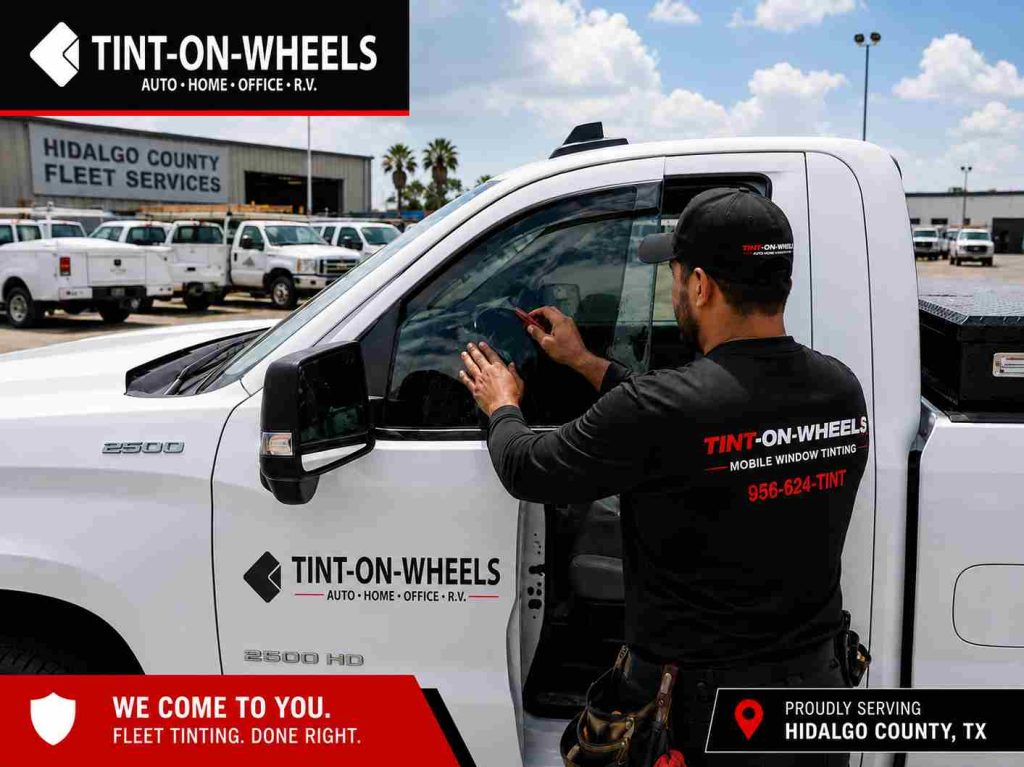
Mobile window tinting brings the installation crew, materials, and equipment directly to a jobsite, shop yard, fleet lot, or home garage anywhere in the Rio Grande Valley. For plumbers, electricians, HVAC techs, roofers, and fleet operators who cannot afford to lose a service vehicle for half a day, mobile service is the difference between scheduling tint and putting it off another season.
Tint-On-Wheels schedules around the truck’s working hours, uses an existing shaded space such as a shop bay, cleans each window, cuts and shapes the film, and completes installation in roughly the same 90 minutes to two hours a shop visit would take. The truck stays at the yard the entire time.
Mobile service is vehicle-only at Tint-On-Wheels. Residential and commercial building tinting happens at the property. Fleet operators with multiple trucks can schedule a mobile crew to tint several vehicles in sequence on a single yard visit.
⭐⭐⭐⭐⭐ “Like you. You’re not always sure about getting great work done at a good price. Well I have to say the service was 5 star. They came right to our RV park and did all our windows on a 43 ft 5th and our semi truck windows. I can’t say enough about the service and quality of work. I so recommend Tint on Wheels.”
- Russ Myslichuk
Mobile installation runs Monday through Friday throughout Cameron, Hidalgo, Starr, and Willacy Counties. Saturday hours at the McAllen shop are 8 AM to 3 PM for auto tinting only. See mobile window tinting for service details.
What Does Professional Work Truck Tinting Actually Cost?
Work truck tinting cost depends on cab configuration, number of windows, film grade, and whether the windshield is included. A standard crew cab pickup with four side windows and a rear cab window falls into a price range similar to a midsize SUV at most McAllen shops.
Cost factors:
Cab configuration. Regular cab equals two side windows plus a rear. Extended cab adds rear quarter windows. Crew cab adds two full-size rear doors.
Film grade. Dyed is cheapest but performs poorly. Carbon sits in the middle. Ceramic commands the highest price and the longest lifespan.
Windshield treatment. Ceramic windshield strips or full-windshield clear ceramic (over 70% VLT) deliver the biggest dashboard heat reduction and remain Texas-legal.
Old tint removal. Stripping failed film adds $25 to $50 per window depending on adhesive condition.
Fleet pricing. Multiple-truck installations from one fleet typically qualify for volume pricing arranged with the shop owner.
Tint-On-Wheels offers 0% financing on vehicle tinting plus discounts for military members and first responders. For the full pricing structure across film types and percentages, see the complete window tinting guide for Texas.
What Happens If You Skip Tinting Your Work Truck?
Skipping window tint on a work truck driven daily in the Rio Grande Valley accelerates interior wear, shortens tool life, and increases driver fatigue across long shifts. The cost of the avoided tint job shows up elsewhere within 18 to 24 months.
Untreated cabs reach 140 to 160°F in summer. Dashboard plastics dry out and crack. Vinyl door cards warp at the upper edges. Steering wheels glaze over. Cordless drill batteries lose runtime, adhesive tubes cure inside packaging, and sensitive testing equipment fails earlier than rated lifespan.
Driver fatigue is the most expensive cost. A crew working out of a 115°F cab between calls in Mission, Pharr, Weslaco, or Mercedes is slower and makes more errors than a crew running tinted trucks. Insurance actuaries already adjust premiums for fleets with documented climate control upgrades.
Quality ceramic work truck window tint holds its performance for a decade, and Tint-On-Wheels backs every vehicle installation with a lifetime warranty against bubbling, peeling, or color shift.
What Results Can You Expect After Professional Installation?
A professionally tinted work truck runs measurably cooler, holds its interior condition longer, and protects the cargo and crew working out of it day after day.
Expect cab temperatures 15 to 25°F lower than an untinted truck parked side by side. Expect AC compressors to short-cycle less, which extends compressor life and reduces fuel burn. Expect dashboard temperatures to stay within tablet and phone operating range. Expect lithium-ion tool batteries to retain capacity longer through summer.
Long-term, expect the interior to look new at year five and presentable at year ten. Expect resale value to hold because the truck does not show the typical heat damage that signals a fleet vehicle. Expect lower glare on Expressway 83 afternoon runs west toward La Joya.
⭐⭐⭐⭐⭐ “Called David for mobile tinted services on my new F250. They showed up quick and did a great job. Friendly staff as well. I will be using them in the future and would definitely recommend them to everyone!”
- Chris Garza
Schedule Your Work Truck Tinting Before Summer Heat Peaks
Tint-On-Wheels has installed work truck window tint, fleet pickups, service vans, and commercial vehicles across the Rio Grande Valley since 1998. Tint-On-Wheels has earned an overall rating of 4.95 from over 400 customers.
For owner-operators tinting one truck or fleet managers scheduling a yard visit for multiple vehicles, the process is the same: a phone consultation to confirm cab configuration and film choice, an in-shop appointment or mobile dispatch to your location, and a lifetime warranty on every vehicle installation.
For tint percentage guidance, see the 35% window tint guide. For temperature-test data, see does tinted windows reduce heat for real. For full service details and warranty terms, see auto tinting services.
Frequently Asked Questions Window Tint for Work Trucks
How much heat does work truck window tint actually block?
Quality ceramic work truck window tint blocks up to 96% of infrared heat and 99% of UV radiation at the glass. Cab temperatures drop 15 to 25°F compared to untinted trucks. The International Window Film Association documents similar reductions in independent testing.
What is the best tint percentage for a contractor F-150 or F-250?
The best front window VLT for a contractor F-150 or F-250 in Texas is 35%, which clears the 25% legal minimum while delivering strong heat rejection. Rear cab windows can go to 20% or darker under the dual mirror rule.
Will tinting void the warranty on my new fleet truck?
Professional tinting does not void factory warranties on new fleet trucks under the Magnuson-Moss Warranty Act. Manufacturers cannot deny coverage unless they prove the film directly caused a failure. Ceramic and carbon films contain no metal and do not interfere with factory electronics.
Can mobile tinting come to my fleet yard for multiple trucks?
Yes, mobile tinting handles single trucks and multi-vehicle fleet visits anywhere in Cameron, Hidalgo, Starr, and Willacy Counties. Schedule a yard date by phone, and the crew arrives with materials sized for the full appointment.
Does ceramic tint interfere with fleet GPS, ELD, or toll tags?
Ceramic window film contains no metal and does not interfere with GPS, ELD, fleet telematics, toll transponders, cellular signal, Bluetooth, or keyless entry. Only metallic films disrupt signal.
How long does tint take to cure on a work truck?
Window tint cures fully in three to five days under Rio Grande Valley summer conditions. Avoid rolling windows down during that window to prevent edge lifting. Cooler or more humid coastal conditions can extend curing to seven days.
What is the best tint percentage for a contractor F-150 or F-250?
The best front window VLT for a contractor F-150 or F-250 in Texas is 35%, which clears the 25% legal minimum while delivering strong heat rejection. Rear cab windows can go to 20% or darker under the dual mirror rule.
Is there a lifetime warranty on work truck tint installations?
Yes, every vehicle tinting installation carries a lifetime warranty against bubbling, peeling, cracking, or color shift, for as long as the customer owns the vehicle. Lifetime warranty applies to vehicle tinting only.
Does Tint-On-Wheels offer fleet or contractor discounts?
Tint-On-Wheels offers 0% financing on vehicle tinting and special discounts for military members and first responders. Multi-vehicle fleet pricing is arranged directly with the shop owner during consultation.


